The Legacy of UZIKEE and Januwa Moja
In Washington, D.C., where politics and power often dominate the skyline, another kind of monument quietly commands attention one shaped by the hands of artists devoted to ancestry, culture, and community. For decades, UZIKEE often called “D.C.’s Ancestral Sculptor” and his wife, Januwa Moja, have created works that transcend aesthetics. Together, they stand as living bridges between generations, transforming memory into form and tradition into movement.
ELDERS AND WISDOM KEEPERSCULTURAL DEFENDERS AND COMMUNITY PROTECTORS
11/12/20252 min read
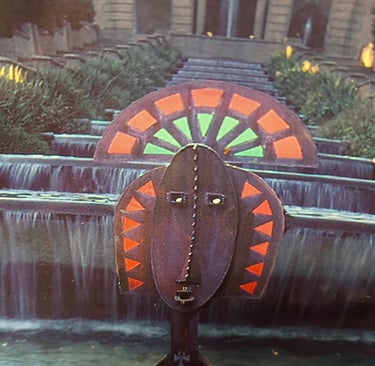
Their art is not simply seen it is felt. It vibrates with the rhythm of Africa, the pulse of diaspora, and the heartbeat of community pride.
The Language of Metal and Cloth
UZIKEE’s sculptures are unmistakable, forged from metal yet alive with spiritual energy. Each piece feels like a conversation between matter and meaning. His work is deeply rooted in African symbology, reinterpreting ancient forms through a contemporary lens. Specific examples of UZIKEE’s major public works include installations in D.C., the Smithsonian, and community spaces such as Malcolm X park.
Standing beside his metalwork is the textile brilliance of Januwa Moja, whose wearable art carries the same ancestral reverence. Her pieces, layered with vibrant fabrics and cultural motifs, are more than garments. They are living testaments to survival and self-expression.
Together, their works embody harmony. Steel and fabric, masculine and feminine, earth and sky, all woven into a single creative lineage.
Preserving Culture, Inspiring Creation
The artistry of UZIKEE and Januwa Moja extends beyond galleries and exhibitions. It reaches classrooms, workshops, and neighborhood corners. They are not only creators but cultural educators, dedicated to ensuring that younger generations understand where they come from and what they are capable of creating.
Before dedicating himself fully to art, UZIKEE (born Nelson Stevens) taught in the Electrical and Mechanical Engineering Technology Department at the University of the District of Columbia. A role that strengthened the technical foundation behind his sculptural practice. His first major commission came in 1970 with a fifteen-foot steel sculpture for the NAACP in Peoria, Illinois. Guided by the belief that “all art is representative of culture,” UZIKEE’s work seeks to awaken ancestral memory, elevate African-American self-esteem, and weave African aesthetics into contemporary consciousness. Working primarily in weathering steel and stained glass, his freestanding, Janus-faced sculptures bridge African ritual and abstract art uniting the spiritual traditions of Africa with the forms of the modern world.
When he decided he needed a partner compatible with the future he was Building Uzikee found his wife Januwa Moja. Januwa has been celebrated as a visionary fiber artist, and in the past decade, she has expanded her practice into glass assemblage and mosaic art. Her work and community programs are rooted in cultural affirmation, using creativity as both a mirror and a medicine. Guided by a belief in the arts’ power to heal and inspire, Moja continues to create pieces that spark social change, restore pride, and celebrate the enduring strength of African heritage.
Their commitment reminds us that culture isn’t static. It’s passed down, shaped, and reimagined with each generation and that the work of preservation is also the work of evolution.
Art as Ancestral Continuum
To encounter a UZIKEE sculpture or a Januwa Moja garment is to encounter time itself. It is the merging of ancient wisdom and modern consciousness. Their art speaks to the continuity of Black creativity, the unbroken line connecting artisans of the past to the visionaries of today. In this way, their art serves as both remembrance and renewal. A way of saying that the stories of our ancestors live not only in museums, but in our hands, our work, and our communities.
The legacy of UZIKEE and Januwa Moja is more than individual success. It’s collective empowerment. They have shown that creativity can be a form of cultural protection, that art can preserve history while igniting new imagination. Their journey challenges us all to honor creative legacies while making space for new voices. To teach, to mentor, to create, not as isolated acts, but as ongoing contributions to a living cultural ecosystem.
As guardians of ancestral artistry, UZIKEE and Januwa Moja remind us that to make art is to remember and to remember is to rebuild.


Sign Up for Text Updates
Get text messages sent directly to your phone to stay up-to-date on the Fellowship's life-saving work around the world.


Subscribe to our Newsletter
Stay informed about issues affecting Africa, the African descendant nation, and Africa American relations, receive Daily Devotional and more
Who We Are
Who We Help
Latest News
Learn
Act
Ways to Give
Also of interest
@ 2025 International Fellowship of Black Americans and Africans ®
1705 East Joppa Rd
Parkville MD 21234
info@ifbaa.org
1-855-984-3222
A 501(c)(3) tax-exempt, non-profit organization.
The Fellowship's tax identification number is 39-4751944
Privacy Policy |